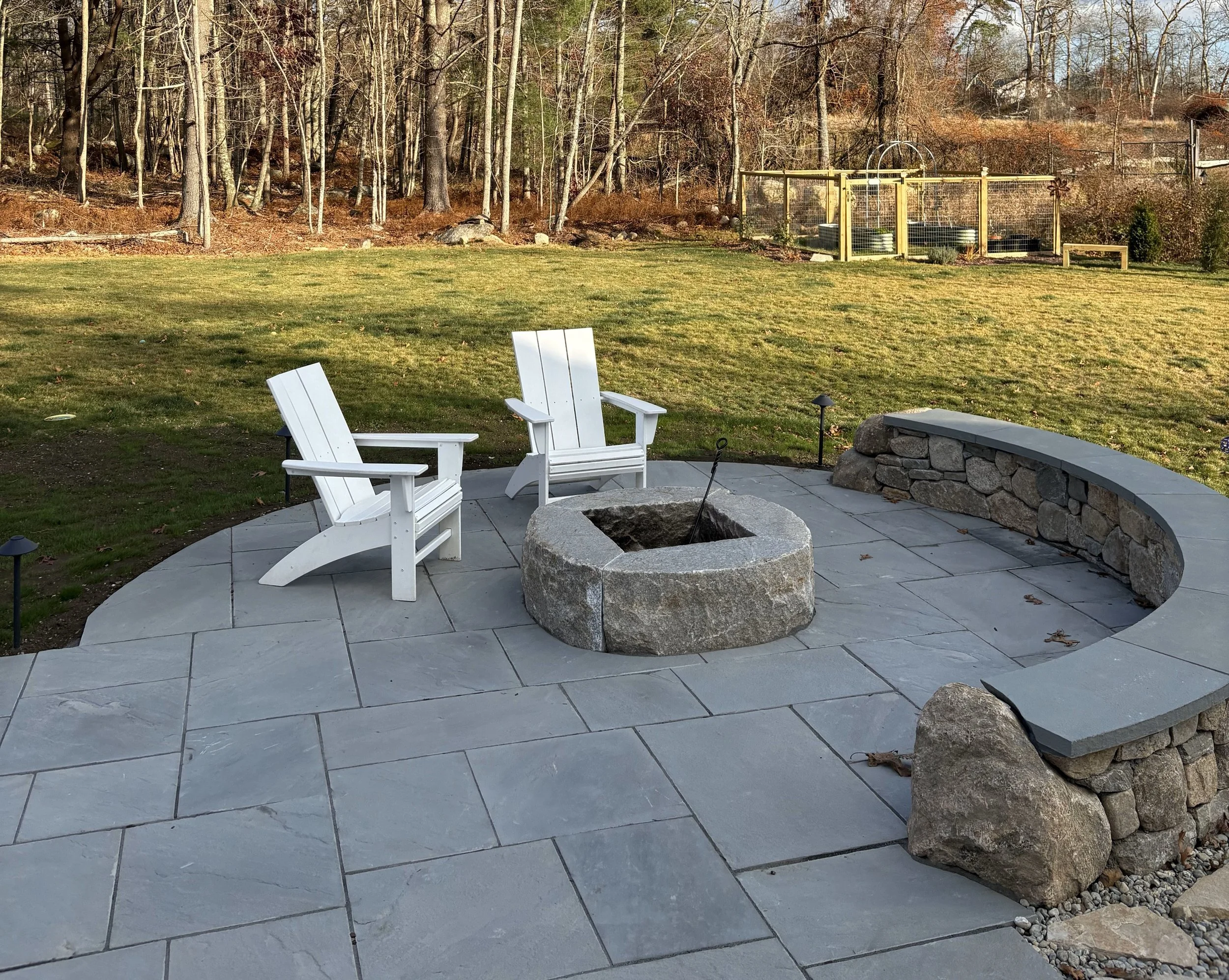
By the time a new patio, wall or planting bed is finished, most homeowners in Wakefield, RI have stopped thinking about landscaping services and started thinking about furniture. The property, meanwhile, has just entered the phase that decides how it looks for the next decade, and that phase belongs to a different kind of work entirely.
Founded in 1987, GrandScapes has grown by building long-term relationships and delivering consistent results, and as a Unilock Authorized Contractor our hardscape installations carry a two-year warranty. Running construction and maintenance under one roof for that long teaches you where the two disciplines meet and where properties fall through the gap between them.
This guide follows a southern Rhode Island property through a year, looking at what the build side owns, what the maintenance side owns, and the handoffs that decide how new work settles in over its first few seasons.
Related: Transform Your Newport or Jamestown, RI Property With Professional Landscaping
What Does the Build Side of a Landscape Project Own?
The build side owns everything structural and everything buried. That covers excavation, subgrade, compacted base, edge restraint, drainage routes, footings, the masonry itself and the elevations the whole property is set to, all decided once and expensive to revisit.
Material selection sits here too, because it is a structural decision as much as a visual one. A paver, a wall unit or a natural stone is chosen for how it behaves through a coastal Rhode Island freeze cycle, and the jointing specified with it determines how the surface ages.
The build side also owns the first condition of the planting. Bed depths, soil amendment and plant spacing are set by the people installing them, and a bed prepared properly needs far less intervention afterward than one planted into whatever was there.
Our landscape design and construction work sets all of that before anything is planted.
What Does the First Year After a Landscape Build Require?
The first year after a build requires watering, and more of it than people expect. A newly planted shrub or tree is living on a root ball the size of its container, and establishment through the first two summers decides survival more reliably than species choice does.
Settling is the other first-year event. Backfill behind a wall, soil around a footing and the ground along a trench line compact further over a season, and the result is a slight dip that wants topping up rather than a defect that wants fixing.
Jointing needs a look as well. Polymeric sand sets hard, but traffic, washing and a first winter show any area that was thin, and topping those joints in year one is a small job that prevents edge creep later.
What Should a Twelve-Month Walk After a Landscape Build Catch?
A short return visit a year after a build catches almost everything worth catching. Settlement, joint wear, plant losses, irrigation heads now hidden by growth and any drainage behavior that only shows after a wet season are all visible at that point and all inexpensive to address.
Leave it three years and the same list is a repair schedule rather than a maintenance visit. That difference in cost is the practical argument for a maintenance relationship rather than an occasional call.
How Does a Rhode Island Year Divide Landscape Work?
Spring is cleanup, bed edging, the first fertilization timed to soil temperature and the start of mowing. It is also when winter damage becomes visible, which makes it the natural moment for repairs rather than the moment to discover them.
Summer is upkeep and vigilance. Mowing height does more for turf quality through a coastal July than any product does, and this is when irrigation problems, drainage faults and plant stress announce themselves.
Late summer into fall is the heavy agronomic work: aeration, overseeding and the final feed, all timed to the window when cool-season grass is putting energy into roots. Fall is also the right season for hardscape, because field crews are released from mowing and the ground is still workable.
Winter belongs to design. Drawings, revisions, material selection and permitting take weeks of calendar time and no field time at all, which is why the projects that go smoothly in May were decided in January. Our landscape maintenance schedule is set against the same calendar.
Which Landscape Problems Are Maintenance and Which Are Construction?
A thinning lawn in one corner is usually a maintenance question until it keeps coming back in the same corner, at which point it is a drainage question. The distinction matters because one is solved by a treatment schedule and the other by moving water.
A wall that is weeping, staining or leaning is construction, regardless of how it is described. Drainage behind a retaining structure is a build decision, and no amount of maintenance compensates for its absence.
Settled pavers sit in between. A single unit that has dropped is a lift and reset, while a whole area that has dropped in a pattern is the base telling you something, and resetting the surface without addressing the base buys a season.
Having both disciplines in one company is what gets that diagnosis right quickly, because the person looking at the symptom asks the person who built it. Our retaining and seating walls are built with that drainage detail from the start.
What Does Coastal Exposure Change on a South County Property?
Coastal exposure adds salt and wind, and both do real work on properties toward Narragansett, Jamestown and the south shore. Salt spray scorches foliage on species not chosen for it, and persistent wind both dries plants out and physically shapes them over time.
Plant selection answers most of it, and that answer belongs at design rather than as a correction afterward. A bed planted without regard to exposure edits itself over two winters, usually at the most visible plants.
Hardscape feels it too. Salt-laden air accelerates corrosion on fixings, railings and fixture housings, which is an argument for brass, copper and stainless in positions where a coated finish would be the cheaper first choice.
Related: Keep Your Lawn Pristine for Outdoor Activities With Professional Lawn Care in Charlestown, RI
How Should Planting Beds Be Maintained So the Design Survives?
Planting beds survive as designed when pruning preserves shape rather than reducing size. A shrub cut back to the same height every spring loses the form it was chosen for, and within a few years a mixed border reads as a hedge of unrelated plants.
Species timing governs the calendar. Spring bloomers set next year’s buds shortly after flowering, so a fall cut removes the display, and working to a pruning schedule built from what is actually planted is one of the quieter arguments for crew continuity.
Edging does more visual work than anything else on the list. A cut edge between lawn and bed holds a line, stops turf creeping into mulch and gives a mower something to run against, and it needs recutting through the season rather than once in April.
What Keeps a Paver Surface Looking New?
A paver surface stays looking new with three small jobs done occasionally. Joint material gets topped where it has thinned, the surface gets washed before organic staining sets, and edge restraint gets checked where a field meets lawn or soil.
Sealing is optional and worth understanding before committing. A sealer deepens color and resists staining, and it also has to be maintained on a cycle thereafter. Going unsealed is a legitimate choice, while starting and stopping is the option that looks worst.
Winter treatment matters in this climate. De-icing products vary considerably in how aggressive they are toward concrete units and natural stone, and the least expensive product on the shelf is often the one doing the damage that shows up in April.
Our patios and walkways are specified with winter treatment in mind.
What Does Turf Need on a Southern Rhode Island Property?
Turf on a southern Rhode Island property needs the right mowing height before anything else. Mowing high shades the soil, slows moisture loss and keeps the crown out of direct heat during the few weeks in high summer that decide how a lawn looks in September. It costs nothing, it is the most effective turf decision available, and it is the one most often gotten wrong.
Aeration is the second need, and on the compacted soils common around older properties here it is routine rather than optional. Core aeration pulls plugs, opens channels for air and water, and makes everything applied afterward considerably more effective.
Overseeding follows aeration in the same window, because seed dropped into open holes in warm soil under cooling air has the conditions it needs. Doing either without the other, or doing both at the wrong end of the season, wastes most of the work.
How Do Shade and Salt Change Lawn Care Near the Coast?
Shade and salt each call for a different approach on the same lawn. Mature canopy changes which grasses survive underneath it, and running one seed blend across a whole property produces exactly the patchy result homeowners call about.
Fine fescues tolerate shade in a way that ryegrass does not, so the mix under a canopy differs from the mix on an open front lawn.
Closer to the water, salt is the limiting factor instead. Turf along an exposed boundary takes spray that burns leaf tissue, and recovery there depends more on irrigation to flush salts through the root zone than on anything applied as fertilizer.
How Does Poor Drainage Show Itself Over a Season?
Poor drainage shows itself slowly, and in the same place each time. A corner that stays wet for three days after rain in April does the same in October, and the turf in it thins, then fails, then hosts whatever tolerates standing water.
Reading that pattern is part of a maintenance relationship rather than a separate investigation. Somebody on the property regularly notices where water sits, how long it stays and what it is doing, and that observation is what turns a recurring complaint into a solvable grading or drainage project.
Hard surfaces concentrate the problem. A roof dumping into a lawn corner delivers far more water to that square footage than rainfall alone, and the remedy is often small, but noticing it takes somebody being there more than once a year.
What Does Crew Continuity Deliver on a Maintenance Account?
Crew continuity delivers knowledge of the property. A crew that has returned for several seasons knows which bed dries first, which corner holds water, which shrub is a replacement and which gate sticks, and none of that is written down anywhere while all of it shortens every visit.
Our crews include people who have been here 19, 20, even 25 years, and the practical effect on a maintenance account is that the property is read rather than processed.
It also changes what gets reported. Somebody who knows a property notices a change, and a change noticed early is usually small. The same change noticed by a stranger six months later is a project.
How Should a Homeowner Plan the Next Phase of a Landscape?
The next phase of a landscape should be planned from a drawing of the whole property, even where only part of it is being built. Elevations, drainage routes and buried services set in phase one should anticipate phases two and three, or the later work arrives contradicting the earlier.
Sleeves are the least expensive insurance available. A spare conduit run under a patio during construction costs almost nothing and makes a future lighting circuit, gas line or irrigation run a pull rather than a demolition.
Timing the phases against the maintenance calendar matters too. Hardscape in fall, planting in the shoulder seasons and design through winter is a sequence that keeps each discipline out of the other’s way.
Year-Round Landscaping Services in Wakefield, RI With GrandScapes
A property is built in weeks and maintained for years, and the properties that still look right a decade on are the ones where somebody stayed involved after the last crew left. Our team would rather walk a property now, see what the season did to it and set both the repair list and next year’s schedule in one visit.
Keep your property on one twelve-month plan with GrandScapes landscaping services. Schedule your landscaping services consultation with GrandScapes.
In Summary
How soon after a new installation should maintenance start in Wakefield, RI?
Maintenance on a new Wakefield, RI installation starts right away, and the first season matters most. New planting needs watering on a schedule rather than when someone remembers, and a bed left to fend for itself through its first two summers rarely catches up. Routine mowing and edging wait a few weeks while new turf knits in.
Does hardscape need any maintenance at all?
Hardscape needs less maintenance than planting, but it still needs some. Joint material migrates over several seasons and wants topping up, edge restraint should be checked where a surface meets soil, and organic staining is far easier to wash off early than after a winter. On a coastal property, fixings and metalwork deserve an annual look as well.
Will GrandScapes maintain a landscape another company installed?
GrandScapes takes on landscapes other companies installed, and the first visit is largely diagnostic. We walk the property, work out what was built and how, note anything that will cause trouble, and set a schedule from there. Knowing what is under a surface changes how it is cared for, so we would rather establish that at the start than guess at it for a season.
Does an ongoing maintenance plan affect plant warranties?
An ongoing maintenance plan with GrandScapes comes with extended plant warranties. Planting cared for by the same crew through its establishment years is planting we stand behind for longer, which is one more reason to keep maintenance in place after a build.