
Paver Patio Installation in Wakefield, RI: The Part You Cannot See
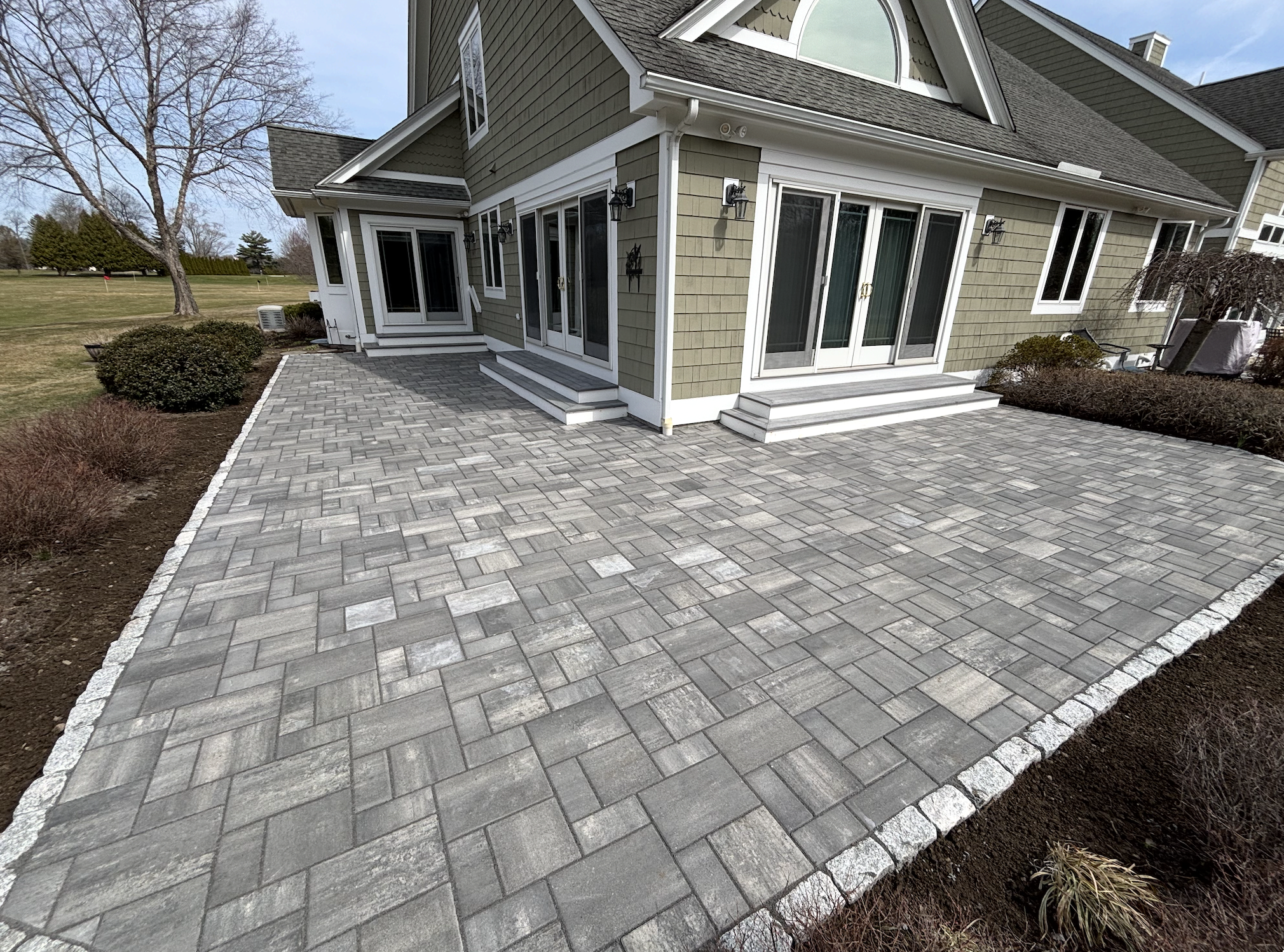
Base failure is what people are describing when they say a patio has gone wrong, and paver patio installation in Wakefield, RI stands or falls on what sits underneath the pavers. Pavers are the cheapest thing to replace and the most expensive to lift.
Everything that decides how a terrace performs in year ten was settled before the first unit was laid, which is why this article spends most of its length below grade.
Since 1987, GrandScapes has worked with Rhode Island families who want outdoor spaces they can enjoy and feel proud of: not just at installation, but years down the line. The second half of that sentence is the part that costs money to deliver.
It’s also why our hardscape work carries a two-year warranty and why we build as a Unilock Authorized Contractor.
Related: 7 Reasons to Prepare Your Property for Winter with Professional Fall Cleanup in Westerly, RI
What Does Paver Patio Excavation Actually Have to Remove?
Paver patio excavation has to remove everything that will move, including topsoil, roots and any organic material. Organic matter breaks down and leaves a void that the base then drops into. The dig goes down to undisturbed subgrade, and the depth is set by what the soil turns out to be rather than by a number written on a quote in advance.
A crew that arrives, scrapes four inches of sod and starts spreading stone is building on the part of the ground least able to carry anything. The excavation is the least photographed stage of the job. It is also the one that decides how the terrace behaves for the next twenty years.
How Is the Subgrade Prepared Once the Dig Is Finished?
The subgrade is proof-rolled, shaped and checked once the dig is finished, before a single stone goes down.
The bottom of the excavation gets compacted in its own right, because a soft spot at subgrade level telegraphs upward through everything above it, and it is shaped to fall in the same direction as the finished terrace so water reaching the bottom of the base has somewhere to go.
On heavy ground a geotextile separation fabric goes down here, which keeps clay from working up into the stone and slowly turning a clean base into a dirty one.
How Much Base Does South County Ground Call For?
South County ground calls for a base depth set by how the soil drains, and the answer changes within a few miles. Sandy coastal soils drain fast and behave well under a conventional base. Inland properties with heavier ground hold water, and water in the base is what frost lifts.
The honest answer follows a test hole: dig, look at what comes out, see how fast a bucket of water disappears, and size the base to that. Any figure quoted before somebody has opened the ground is a guess wearing a decimal point. We would rather dig first and quote second.
Why Does Paver Base Compaction Happen in Layers?
Paver base compaction happens in layers because base material compacts properly only in shallow lifts. Dumping the full depth and running a plate over the top compacts the surface and leaves the bottom loose, which is a slow failure rather than an obvious one.
Three or four inches at a time, each pass overlapping, is slower on site and is the difference between a terrace that holds its level and one that dishes.
What Does Freeze and Thaw Do to a Rhode Island Paver Terrace?
Freeze and thaw tests a Rhode Island paver terrace repeatedly through every winter rather than once. Our winters cycle above and below freezing many times, and each cycle expands whatever water is held in the ground beneath the terrace.
A well-drained base lets that water leave before it freezes, which is the whole argument for open-graded stone and proper compaction. A base that holds water lifts a little each winter and settles unevenly each spring. After a few years the surface reads as a series of small waves that no amount of resanding fixes.
Where Is the Water on a Paver Patio Supposed to Go?
Water on a paver patio is supposed to run away from the house, at a fall a person cannot feel underfoot but water finds. Roughly a quarter inch of drop per foot carries surface water off a terrace without anyone noticing the slope. It has to run somewhere sensible rather than into a bed that turns into a bog or toward a foundation.
On a property where the natural fall works against you, the answer is a drain line under the base rather than a steeper surface. A terrace you feel tilting is a terrace nobody puts a table on. The drainage plan gets drawn before the excavation depth is set.
How Should a Paver Terrace Relate to the House and the Doors?
A paver terrace should sit at a height that works at every threshold, with fall away from the building. Getting the finished surface level right against a door sill has to be settled before excavation rather than discovered at laying, because the base depth and excavation depth both follow from it.
A terrace a fraction too high at a slider traps water against the house, one too low leaves an awkward step, and where a property falls away sharply the answer is usually a change of level in the terrace itself.
What Does the Bedding Layer Under Pavers Do?
The bedding layer gives the pavers a consistent surface to sit on, and it is the layer most often misused. A thin, even course of coarse sand or a specified bedding aggregate is screeded to a uniform depth and left undisturbed, because its job is to bed units level rather than to correct anything.
Using the bedding layer to make up for a base that was not properly graded produces a terrace that looks flawless for one summer and then follows the shape of the base underneath it. Consistent depth across the whole field is the point. Anything thicker in one place consolidates more in that place.
What Holds the Edges of a Paver Patio in Place?
An edge restraint spiked into the compacted base, rather than into the setting bed, holds the edges of a paver patio in place. A paver field is held together by friction between units, and that friction exists only while the perimeter is confined.
Lose the edge and the outer units creep outward, the joints open, sand washes out, and the failure works its way inward over a few seasons. It is a small line item. It is also the one we most often find missing on patios somebody else built, usually along the curve where it was hardest to install.
How Do the Joints Between Pavers Behave?
The joints between pavers lock the units into a single interlocking field, and when joint sand washes out the surface behaves like a collection of loose stones. Polymeric sand binds and resists washout and weed growth, though it has to be installed dry and watered in exactly as specified or it hazes the surface and needs scrubbing off.
Regular sand is more forgiving to install and needs topping up, and either is legitimate as long as the choice is made openly rather than discovered on the invoice.
What Does Salt Air Change About Paver Selection?
Salt air moves durability ahead of appearance in paver selection. Properties near the water in Narragansett, Point Judith and along the shoreline get salt in the air and on the surface, and it works on anything porous. Dense, low-absorption concrete pavers handle it, while softer natural stone and lightly made units pit and spall.
Sealers slow the process and commit you to reapplying them. The right conversation before ordering is about absorption rate and what happens after ten winters, rather than which sample looks best dry on a table.
Working as a Unilock Authorized Contractor gives us a product range built to published absorption specifications for exactly that conversation.
How Should a Paver Patio Pattern and Layout Be Settled?
A paver patio pattern and layout should be settled on the ground, at full size, before anything is cut. Running a line and marking the footprint in paint tells you more in ten minutes than a drawing does in a week: whether the table fits with chairs pulled out, whether the route from the back door lands where you want it, and whether there is room to walk behind somebody seated.
Pattern choice follows the shape. A running bond suits a long rectangle. A herringbone holds up better where vehicles or heavy foot traffic cross it, which is why it is a common choice on driveways and entrances.
How Are Steps and Grade Changes Handled in a Paver Patio?
Steps and grade changes in a paver patio are handled as structure rather than paving. A step carries concentrated load on a small footprint and is the first thing a person feels if it has moved, so risers stay consistent across a flight, treads take a whole foot, and the assembly sits on its own footing rather than the field base.
Where a property falls steeply, a low seating wall often does more than an extra flight of steps and gives the terrace an edge worth sitting on.
Related: Discover the Charm: Basketweave Paver Patio for Your Westerly or Charlestown, RI Property

What Should a Paver Patio Proposal Spell Out?
A paver patio proposal should spell out excavation depth, base material and compacted thickness, the bedding layer, the edge restraint type, the joint sand, the fall and where water is directed, and what happens to the spoil. It should say who restores the lawn where the machine ran, and it should name the paver and finish rather than a color family.
A document carrying those numbers and one carrying only a square footage and a total are not comparable. Reviewing our patio and walkway design and installation in South County alongside them shows what a complete scope looks like. The detailed version is the one you hold a contractor to.
What Separates Two Paver Patio Quotes at a Similar Price?
Depth, layers and edges separate two paver patio quotes at a similar price. Ask each company how deep they dig, how thick the compacted base is, how many lifts they compact it in, what edge restraint they use and where the water goes.
Four short answers and one vague one tell you which quote is carrying the base work, since price differences on paving are usually excavation and stone differences wearing a disguise.
What Does the Site Look Like During Paver Patio Installation?
The site during paver patio installation looks worse than the finished photographs and better than people fear. There will be a machine, a stockpile of excavated material, a pile of base stone and a run of disturbed ground where the route to the work crosses the lawn.
Good practice means boards or mats under the traffic route, spoil kept off turf, and material staged where it does not block the house. The stage that looks most alarming is the open excavation, which is also where the quality of the whole job is decided. It is worth walking the site at that point rather than waiting for the surface to go on.
Which Season Suits Paver Patio Installation?
Autumn suits paver patio installation best, though any month the ground is workable will do. Spring books out early and competes with wet ground, and midsummer puts the disruption in the weeks you most want the yard.
Autumn gives firm ground, cooler working conditions and a terrace with a full winter to settle, so any small first-season movement shows up while the crew is still in the neighborhood rather than in July.
What Maintenance Does a Paver Terrace Actually Need?
A paver terrace needs an afternoon of maintenance a year: a spring sweep and rinse, a joint check, and early weed removal. Top up sand where it has washed low, particularly at the downhill edge, and pull anything growing in a joint before it widens.
Reseal only if the surface was sealed originally and water has stopped beading. Near the shoreline, a rinse after a storm takes salt off the surface before it works in. That is the whole list, and our two-year hardscape warranty backs the work while the terrace settles into its first seasons.
Plan Your Paver Patio Around the Ground, Not the Sample Board
Show us the space and we will dig a test hole, look at how the ground drains and tell you what the base has to be before anyone opens a sample board.
GrandScapes puts the excavation depth, the base build-up and the drainage in writing, so the terrace you buy is compared on the parts that hold it up. Schedule your paver patio installation consultation with GrandScapes.
In Summary
How deep does a patio base need to be in Rhode Island?
A patio base in Rhode Island needs to be deeper than most homeowners expect, with the exact figure set by the soil and frost rather than by the paver. Heavy or poorly draining ground needs more depth than sandy coastal soil, which is why GrandScapes sets the number after the test hole rather than before it.
Will a paver patio settle over time?
A paver patio settles a small amount in its first season as the base takes its final compaction. Dips that keep growing after that are a base problem rather than a paver problem, and they get worse rather than better.
Can a patio be built over an existing concrete slab?
A patio goes over an existing concrete slab only when the slab is sound, drains the right way, and the resulting height still works at the door threshold. An overlay on a cracked or heaving slab carries every fault underneath it straight up to the surface.
Related: Hardscape Contractors in Wakefield, RI: How to Vet One and What a Full Scope Includes
